
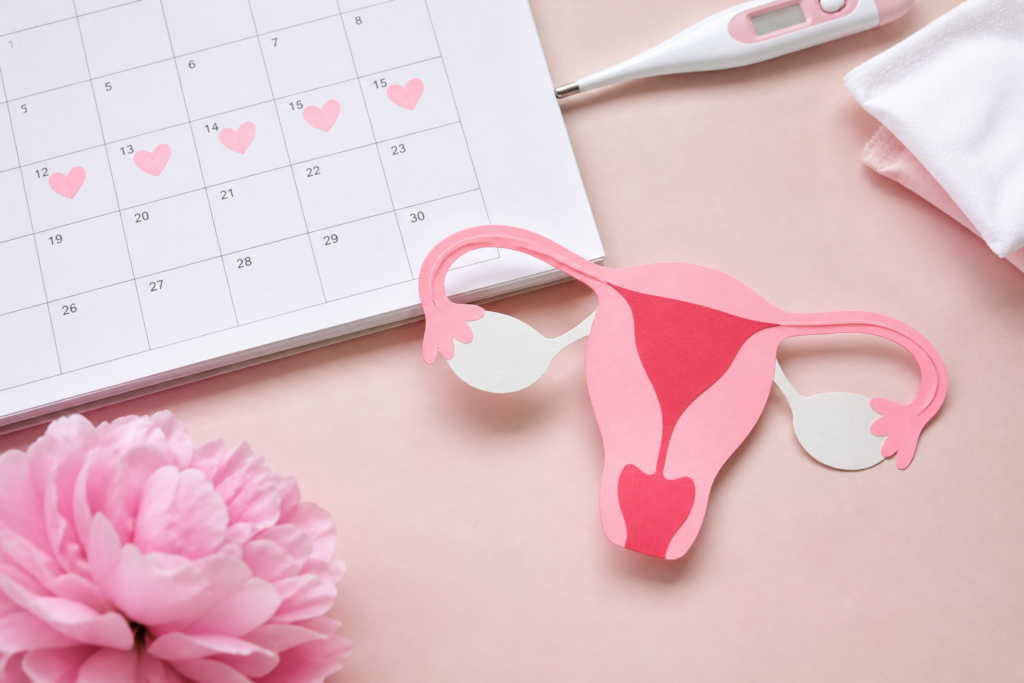
If you already track your periods, you have a running record that most people never think to read carefully. The patterns in that data — cycle length, flow, pain, ovulation signs — can tell you a great deal about your menstrual cycle and fertility health before you ever sit in a clinic waiting room. The tools you already use, whether that is a period app, basal body temperature (BBT) charts, cervical mucus observation, or ovulation predictor kits (OPKs), are genuinely useful for spotting those patterns. What they cannot do is diagnose conditions or replace medical testing.
This article will help you establish what a hormonally healthy cycle usually looks like, identify the specific patterns and symptoms that may hint at fertility problems, understand what your tracking data can and cannot tell you, and know when it is time to move from self-monitoring to a specialist assessment or to explore treatment options such as IVF.
Your healthy-cycle baseline: timing, flow and ovulation cues
A typical cycle runs from 24 to 35 days, measured from the first day of full flow to the day before the next period starts. What matters most is not hitting a precise number but staying fairly consistent month to month, because a cycle that reliably lands in the same range is a good indicator that ovulation is happening predictably.
The cycle splits into two phases. During the follicular phase, rising oestrogen drives the development of a dominant follicle and thickens the uterine lining. Ovulation ends this phase, after which the luteal phase begins: progesterone rises, matures the lining, and holds it ready for a potential embryo. The luteal phase typically lasts around 12 to 14 days. Periods normally last 2 to 7 days, with total blood loss of roughly 20 to 90ml (about 1 to 5 tablespoons), and cramps manageable with standard pain relief are within the usual range.
A one-off unusual cycle after illness, disrupted sleep, or a stressful patch at work is rarely a cause for concern. It is the pattern across several months that carries the most information.
Cycle patterns that can hint at underlying fertility issues
Single odd cycles happen to almost everyone. What merits attention is a pattern that repeats: a consistent shift in length, flow, or pain showing up month after month.
Consistently short cycles (under about 24 days) can suggest the follicular phase is compressing, meaning eggs may be maturing faster than usual or the luteal phase is not holding its full length. This pattern is more common as ovarian reserve declines, which is why it often appears in the years approaching perimenopause, but it can occur earlier too. It may also reflect progesterone dropping before an embryo has a realistic chance to implant.
Consistently long cycles (over about 35 days), or cycles that vary widely from month to month, usually signal that ovulation is not happening on a regular schedule, or is not happening at all. Polycystic ovary syndrome (PCOS) is the most common underlying cause, as it disrupts the hormonal signalling between the brain and the ovaries. Thyroid imbalances, elevated prolactin, significant energy deficit from undereating or intense exercise, and being substantially under or overweight can all produce the same result.
Cycles that stop altogether for three months or more, when you are not on hormonal contraception, point strongly to absent ovulation. Hypothalamic amenorrhoea — where the brain essentially pauses the reproductive system in response to low body weight, eating disorders, or extreme physical stress — is one common cause. Premature ovarian insufficiency and scar tissue within the uterine cavity are others, and the distinction matters enormously because each has a different treatment path.
Very heavy flow — soaking through high-absorbency protection every one to two hours for several hours, passing large clots, or bleeding beyond seven days — can reflect anovulatory cycles, where prolonged exposure to oestrogen without a progesterone counterbalance causes the lining to build and shed unpredictably. Structural issues such as fibroids or polyps can have the same effect and may also interfere with implantation or raise miscarriage risk. Anaemia is a practical consequence worth checking if heavy periods are a long-standing pattern.
Very light flow (barely more than spotting) may indicate a thinner uterine lining, lower oestrogen levels, or uterine scarring, any of which can reduce the chances of a fertilised egg implanting successfully.
Severe menstrual pain that keeps you off work or unable to function normally, pain during sex, or discomfort that lingers across the month rather than peaking in the first couple of days of bleeding is strongly associated with endometriosis and adenomyosis. Pain severity alone does not determine how much these conditions affect fertility, but both can influence egg quality, tubal function, and the uterine environment.
Spotting between periods is worth noting in your tracker. Light spotting around ovulation can be entirely benign, but spotting that is heavier, happens at other points in the cycle, or is a new pattern for you can point to hormonal imbalance, fibroids, polyps, infection, or, in rare cases, changes in cervical cells that need assessment regardless of your fertility plans.
A short luteal phase — fewer than around 10 days between a confirmed ovulation (shown by a BBT rise or a positive OPK) and the start of the next bleed — may mean progesterone is not sustaining the uterine lining long enough. It is worth flagging to a doctor, though only blood tests at timed points in the cycle can confirm whether progesterone levels are actually insufficient.
The important caveat across all of these is that a pattern in your tracking data raises a question; it does not answer it. The cause and its exact impact on your fertility cannot be established without medical evaluation.
What apps and body signs can (and cannot) tell you about fertility
Period-tracking apps are excellent at one thing: building a picture of your cycle over time. Once you have several months of data, an app can show you your average cycle length, highlight variability, and estimate your likely fertile window. That estimate is genuinely useful if your cycles are regular. If they are not, the app is essentially extrapolating from unreliable data, so treat the predicted ovulation date as a rough guide rather than a confirmed fact.
BBT charting adds a layer of confirmation. Progesterone causes a sustained temperature rise after ovulation, typically around 0.2°C or more held for at least several days, so a clear biphasic chart tells you that ovulation has very likely occurred. It also lets you estimate your luteal phase length by counting from that temperature shift to the start of your next period. The limitation is that BBT is retrospective: it confirms ovulation after the fact rather than predicting it in advance. Illness, alcohol, a disturbed night, or shift work can all produce misleading readings, so a single odd temperature rarely means much.
Cervical mucus changes are one of the more immediate ovulation signals available without any equipment. Around ovulation, rising oestrogen produces mucus that is clear, slippery, and stretchy — often described as raw egg white — creating a more hospitable environment for sperm. Drier or thicker mucus at other points in the cycle indicates lower fertility. Infections, antihistamines, and some hormonal medications can alter mucus quality and make the signal harder to read.
OPKs detect the surge in luteinising hormone (LH) that typically precedes ovulation by 24 to 36 hours, making them one of the most practically useful home tools for timing intercourse or insemination. A positive OPK is a reasonably reliable signal that ovulation is likely imminent, though in conditions such as PCOS, where LH can be persistently elevated, false positives are possible.
None of these tools, used alone or together, can tell you whether your fallopian tubes are open, whether your ovarian reserve is adequate for your age, whether there is uterine scarring or structural abnormality, or what a partner’s sperm analysis looks like. A reassuring chart does not guarantee easy conception, and a messy or unclear chart in one month does not mean infertility. What tracking does well is generate the kind of specific, time-stamped symptom record that a GP or fertility specialist can actually use, and bringing several months of data to an appointment accelerates the assessment considerably.

What apps and body signs can (and cannot) tell you about fertility
Menstrual cycle and fertility health: when to seek specialist help
If your cycles are regular and you are trying to conceive through unprotected intercourse or donor insemination, the standard guidance is to seek a fertility assessment after 12 months if you are under 35, after 6 months if you are between 35 and 39, and promptly if you are 40 or over. At 40, time is a meaningful factor and earlier evaluation gives you more options.
Some menstrual patterns justify making an appointment without waiting for those timelines at all: cycles that are consistently shorter than about 24 days or longer than about 35 days, periods that have stopped for three months or more when you are not on hormonal contraception, flow that is soaking through protection every one to two hours or lasting beyond seven days, severe or worsening pelvic pain, pain during sex, significant spotting between periods or after sex, or a cycle pattern that has shifted noticeably without any obvious explanation such as illness or major life stress. If your cycles are irregular or absent, do not wait at all — see a specialist regardless of how long you have been trying.
Early review also makes sense if you have a known condition such as PCOS, endometriosis, thyroid disease, a history of pelvic infection or surgery, or previous chemotherapy, because these can affect fertility in ways that tracking alone will not reveal. If you are planning solo conception or same-sex family building, an early baseline assessment of your cycle and ovarian reserve helps you plan realistically from the start.
At an initial fertility appointment, you can expect a detailed history drawing on the cycle data you have already collected, a physical examination, blood tests at specific cycle points to assess ovulation hormones, thyroid function, prolactin and ovarian reserve markers, a pelvic ultrasound to look at the ovaries and uterus, and semen analysis if there is a partner producing sperm. Many of the issues that menstrual patterns flag — irregular ovulation, mild hormonal imbalances, small structural changes — are treatable, often with straightforward medication or minor procedures, so seeking help earlier simply means more time to find what works.
From cycle clues to treatment options, including where IVF fits in
The patterns your cycle reveals are a starting point for investigation, not a final verdict. Once testing has clarified the picture, the treatment path tends to follow the diagnosis fairly directly. Irregular or anovulatory cycles linked to PCOS or hormonal imbalance often respond well to ovulation-induction medication. Fibroids or polyps identified on ultrasound may be removed surgically, restoring a more hospitable uterine environment. Thyroid or prolactin irregularities are typically managed with targeted medicines that, once levels normalise, can allow natural ovulation to return.
IVF sits further along that pathway, as a next step rather than a first response. It tends to come into consideration when simpler approaches have not led to pregnancy, when there are multiple factors in play (such as a combination of ovulatory difficulty and low sperm count), when egg quality or ovarian reserve is reduced and time is pressing, when there is severe endometriosis or significant uterine or tubal damage, or when the cause remains unexplained despite thorough investigation. In these circumstances, IVF in Bangkok may be worth exploring, particularly once simpler options have been exhausted. Egg freezing, which uses the same stimulation process as IVF, is also worth discussing early if your cycle patterns or age suggest that ovarian reserve may be declining, or if you want to preserve options before starting other treatments.
The decision to pursue IVF is never made on cycle patterns alone. It follows from the full clinical picture: your age, your diagnosis, how long you have been trying, and what matters to you. If your tracking is raising questions, or you are reaching any of the thresholds discussed above, a consultation with a fertility team at a clinic such as Millennium IVF Clinic can help translate your months of cycle data into a clear assessment and a plan suited to where you actually are.
A practical place to start: pull up your last 6 to 12 months of tracking data and look for the patterns this article has described. If things look broadly consistent and reassuring, continue tracking with more confidence. If you spot repeated irregularities in length, flow, pain, or ovulation signs, use those notes as the basis for your first conversation with a GP or fertility specialist. The data you have already gathered is more valuable than most people realise.